


The founding principle of this company has always answered a conservation question: how do we create meaningful ocean experiences without disrupting the marine life we're there to witness?
Legal Distances & Vessel Size
Federal law is clear, as outlined by the National Oceanic and Atmospheric Administration (NOAA): vessels and divers in Hawaii’s waters must stay at least 100 yards (91 meters) away from humpback whales when on or in the water. Spinner dolphins get their own protection — it's illegal to swim with, approach, or remain within 50 yards (46 meters) of them in Hawaiʻi. Hawaiian green sea turtles need at least 10 feet (3 meters) of space whether they're in the water or resting on the beach, and Hawaiian monk seals require at least 50 feet (15 meters) of space on land and in water.
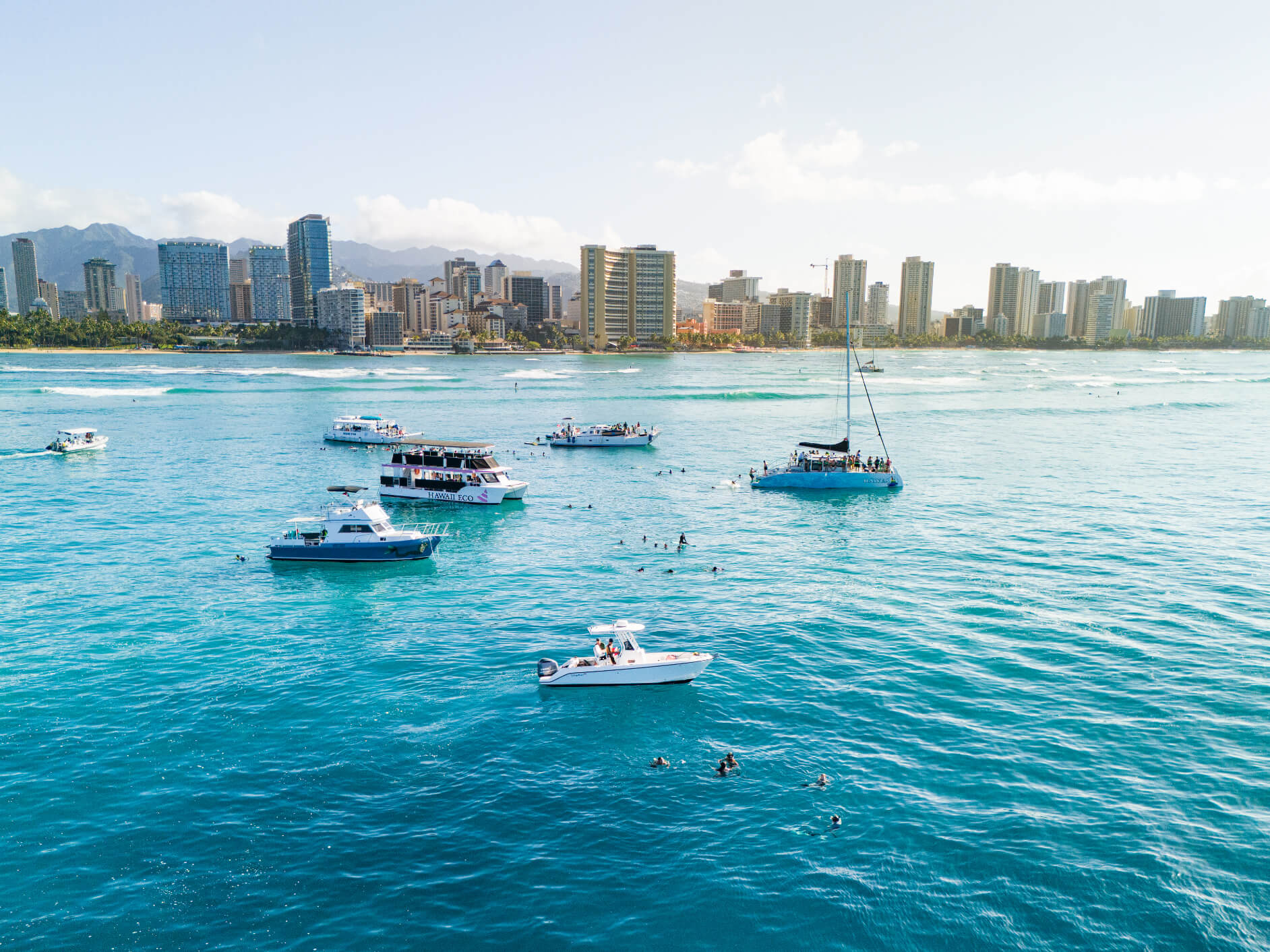
Any operator will tell you they follow these rules. Fewer will tell you how much harder that gets with more bodies and a larger boat to manage. A 6-passenger vessel can throttle down, hold position, and pivot the second a whale changes direction. A larger vessel with a full deck of guests pushing for a rail view has more inertia and more blind spots, and may not react as quickly in the same situation. We're not better people than other captains, we just have a boat small enough that holding the legal distance is an easy decision and immediate action.
Noise and Wake Are a Stress Issue for Wildlife
Whale researchers have spent decades documenting how vessel traffic affects marine mammal behavior, even from a legal distance: disrupting vital activities like feeding, resting, movement, and communication. NOAA's guidance recommends limiting observation time of marine mammals to 30 minutes or less, noting that continued presence and the cumulative impact of multiple vessels can cause animals unnecessary stress — which is exactly why we never park and linger.
A smaller hull also makes less noise and leaves a smaller wake. Engine acoustics matter to animals like humpback whales that communicate and navigate by sound across miles of open ocean. It's noise that is multiplied across every boat in the channel, and another reason we choose to run a quieter 6-passenger vessel.
What a Six Guest Cap Actually Changes, On Deck and Underwater
The conservation argument is the one we lead with, but there's also a practical side to joining a small group tour:
- Every guest gets a window seat. On our boat, nobody misses a whale breach or a chance to see the spinner dolphin pod passing by.
- Smaller snorkel groups stay close and visible. Our guides can keep eyes on six swimmers at once and give personal support and insight throughout the trip.
- The crew can read the water, not just the clock. With fewer guests to manage, our captain and guide have the capacity to seek out a good sighting instead of sticking to an exact route.
- Less wake and noise disturbance for the reef itself, especially around shallower reef sites like Turtle Canyon.
Small by Choice
Getting a small boat was an active choice when starting our company, not a limitation. The same way we choose to partner with Aloha i ke Kai to support local ocean stewardship and conservation, rather than just advertise as "conservation-minded". A six guest limit means that every trip is personal — an opportunity for us to share our love of the ocean while protecting it. We hope that after stepping off our vessel, having witnessed turtles, dolphins, and whales thriving in their natural habitat, you leave feeling more connected to the ocean and inspired to explore the world with greater intention.
Our philosophy is simple: we move through nature as visitors, recognizing that we are entering these animals’ home. We come with curiosity and wonder, but above all, we come with respect. By fostering a deeper appreciation for marine life and the ecosystems they call home, we hope every journey with us inspires a lifelong commitment to thoughtful, responsible travel that contributes to the conservation of our planet.


