


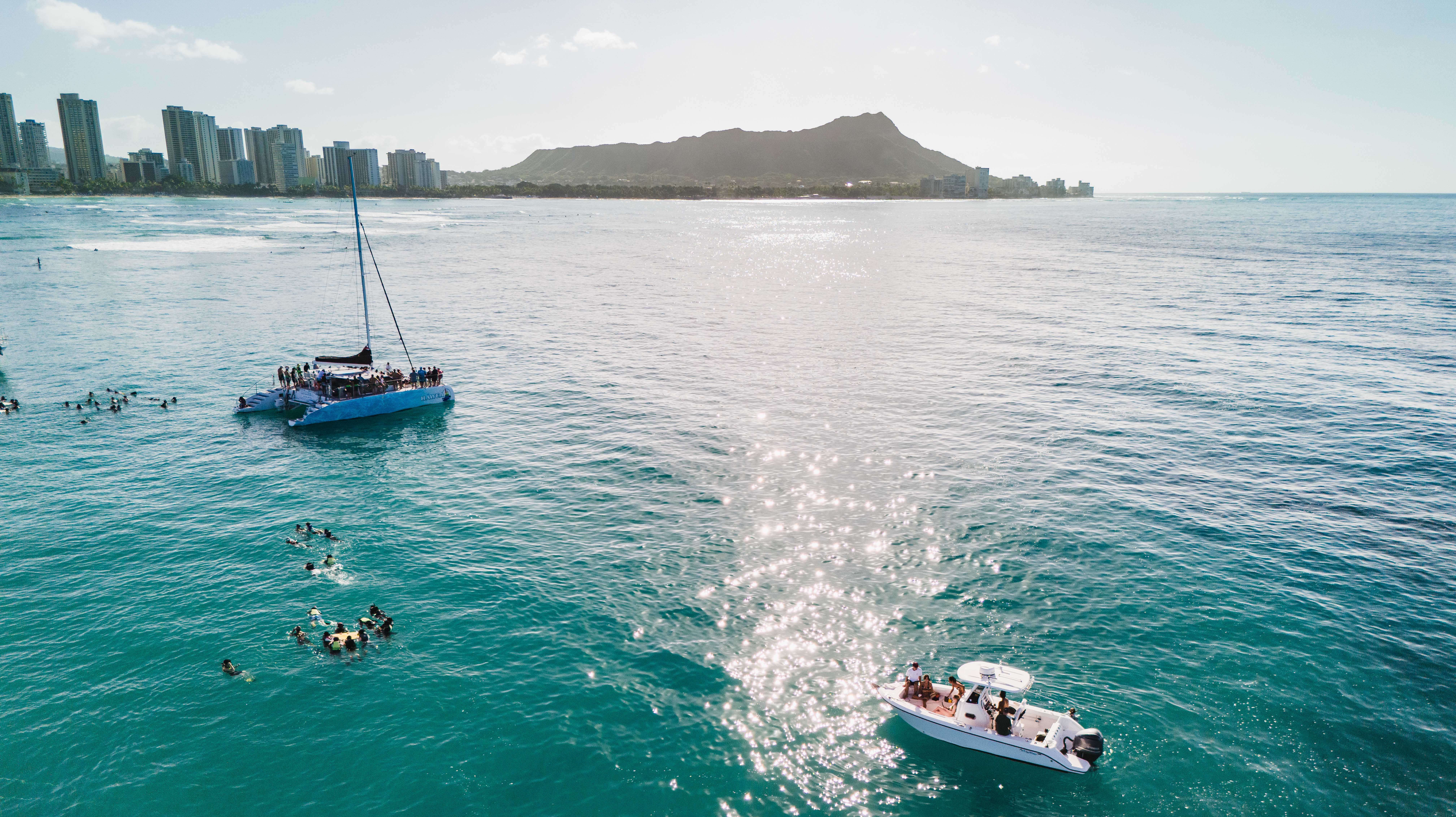
Last year Hawai’i welcomed around 10 million visitors — almost 7 times the state’s resident population. Somewhere between the Mai Tai’s on the beach, waterfall pictures, and sunset cruises, the islands have become a case study on what happens when a place is visited by more people than it can comfortably hold. Trails are eroding and native plants suffer from the introduction of foreign species that hitchhike on unchecked shoes and clothes. Beaches are overcrowded and become polluted from trash left behind. Reefs are stressed from toxic sunscreen and unknowing swimmers’ feet finding ground where they shouldn’t. And the animals that depend on these reefs suffer from the degradation of their habitat caused by the demand to see them, which is often fulfilled in large numbers with little awareness or respect for their livelihood.
In the absence of visitors during the COVID-19 pandemic, the islands’ ecology experienced a prolonged period of little to no human contact. After many years of constant congestion, relief and recovery during this time seemed to be connected to the lack of human presence. At the same time Hawai’i’s economy suffered due to its heavy reliance on tourism, revealing a difficult paradox: tourism can harm our islands, yet our survival depends on it. Bridging this divide requires a shift in how tourists interact with our islands. “Ethical tourism” here isn’t a marketing buzzword — it’s a real, specific set of practices tied to this place’s ecology and culture, and a real set of choices travelers make about where their money and attention go.
The cultural value underneath everything
Most “sustainable travel” advice focuses on climate impact — flight choices, accommodation, and minimizing the carbon footprint. In Hawai’i, there is a deeper principle at work: mālama ’āina. Sustainability was a fundamental and systemic cultural value in ancient Hawai’i described by the term mālama ’āina, which means to care for, preserve and protect the land. This traditional Hawaiian worldview dictates a reciprocal relationship, where humans care for the land and in turn the land provides everything needed to sustain them. Breaking this reciprocity and exploiting resources could be costly to an entire population. While Hawai’i no longer relies solely on the land for what sustains it, the value hasn’t become historical. Mālama ’āina is still a way of life, and the thing that determines whether the land and ocean will thrive for our children and those that come after them.
This is an idea that underlies marine protection and the reason why your spending as a traveler carries weight even after you’ve flown home. While you are here as a visitor, the easiest way to practice it is the phrase most people have heard, but haven’t unpacked: leave a place better than you found it. In practice, this means:
- “Pack it in, pack it out,” and pick up trash: Ensure that everything you bring to the beach, parks, trails, and out on the water leaves with you. If you see any trash isn’t yours, pick it up so it doesn’t harm marine life or pollute the ecosystem it ends up in.
- Take nothing natural and leave the native wildlife alone: Leave rocks, sand, and coral where they belong, and do not touch native wildlife to respect the environment and its cultural weight.
- Support local businesses to support the community: Buy from locally owned businesses whenever possible. Be aware of non-locally owned businesses and corporations that use Hawaiian words and imagery for aesthetic and branding purposes without any real connection to the islands.
- Respect sacred cultural sites: Take time to learn about the history of Hawai’i, and treat historic sites and those actively used for cultural practice with the same respect you’d expect at a place of worship.
Marine protection benefits us all
The ocean is an integral part of Hawaiian culture, and has provided the islands with vital sustenance for generations. Caring for, preserving, and respecting the ocean was a real set of practices in traditional Hawai’i because fishing wasn’t just recreational — it provided vital sustenance for the people, so protection of this resource was necessary for survival and longevity. Today, Hawai’i’s marine life is protected by federal regulations, and a genuinely ethical tour operator treats these as operating principles, not suggestions:
- Reef-safe sunscreen: oxybenzone and octinoxate, found in most conventional sunscreens, are linked to coral bleaching and have been banned for sale in Hawai’i since 2021. On our boat, this is something our crew talks through with guests before anyone gets in the water.
- Legal distance requirements around wildlife: NOAA mandates specific distances from humpback whales, Hawaiian green sea turtles, Hawaiian monk seals, and spinner dolphins. These distances are federal law.
- Passive observation over pursuit: the most respectful encounters happen when we let the animal decide whether to approach. If a curious turtle or pod of dolphins closes the distance, that’s a genuine encounter, not a forced one.
- No touching, chasing, or feeding wildlife: this includes turtles, which despite being one of the most commonly encountered and photographed animals in the islands are protected and should never be handled.
There is real evidence of what happens to a reef when human pressure is absent, even briefly. Researchers studying Hanauma Bay observed its reef quickly returning to natural levels during the pandemic’s tourism lull. Normally a busy tourist destination, just a 7 month period of human absence resulted in clearer waters, denser fish populations, and increased Hawaiian monk seal sightings, suggesting that the reef was under significantly less pressure than usual. Hanauma Bay’s rapid recovery during the pandemic provides evidence that reef ecology is heavily impacted by human activity, suggesting that strategic regulation can foster a more reciprocal relationship where visitors can still enjoy the marine life while protecting the reef from constant, damaging pressure.
Scale matters more than most travelers realize
A small boat carrying six guests moves through the water differently than a large one carrying twenty or forty. By comparison, smaller boats react faster when a whale or turtle appears, and contribute far less noise and wake disturbance near reef systems. Smaller groups also make passive observation easier in practice: with only six guests, our guide can keep eyes on everyone at once, making sure no one drifts too close to an animal, reaches out, or crowds the space, so the animal always sets the terms of the encounter.
Scale is also what makes education possible. On our trips, that looks like live commentary throughout the tour: why we’re holding this distance from the pod of dolphins, what reef safe sunscreen actually prevents, why an animal approaching us is different from us approaching it. The goal isn’t compliance for the hour and a half that someone’s on the tour. Our goal here is that a guest leaves understanding the reasoning well enough to carry it into their next dive, trip, sunscreen purchase, and even into a conversation with a friend who is planning a Hawai’i vacation. Most people aren’t choosing to harm the places they visit — they simply haven’t had the awareness brought to them yet.
Your choices as a traveler carry more weight than you might think
It’s easy to think of ethical tourism as something operators are responsible for and travelers just opt into. In practice, traveler spending is one of the most direct levers on how Hawai’i’s tourism economy evolves:
- Where you spend shapes what survives. Choosing small, local, conservation-focused operators over mass volume tour companies directs money toward the business actually investing in the islands’ long-term health, and signals market demand for more of them.
- What you ask for shapes what gets offered. When travelers search for operators that implement guest caps, documented conservation partnerships, and visible wildlife protocols before booking, it pushes the whole industry toward transparency, because demand shapes supply.
- Who you learn from shapes what you notice, and how you choose in the future. A trip built around connection and education, rather than just sightseeing, changes what you carry home and what you look for the next time you travel anywhere.
This is the thinking behind why we built our own trips around connection and education rather than just sightseeing: people protect what they love, and they love what they know. Most people aren’t consciously making choices or behaving in a way that is harmful to the places they visit — it’s a matter of bringing those choices and behaviors to awareness. Our goal here is to educate people to move about the world with greater consciousness and intention. A guest who understands why a six-guest cap exists, or what stresses marine life and disrupts marine ecosystems, leaves with a reason to keep choosing operators, and making choices wherever they are, that align with it.
Choosing well is the easiest form of activism you’ll do on vacation
You don’t need to change your itinerary dramatically to travel more ethically in Hawai’i. You need to do a little more research before you book, ask questions, and choose operators who can answer them. Pay attention to what an experience is teaching you, not just showing you, about the place you are seeing. Tourism isn’t going away, but the operators you choose, and the questions you ask them, quietly decide what kind of tourism that is. Leave wherever you go better than you found it.


